





The AI image has the perfect color, a beautiful shape, and a buckle nobody can find. Your opening is in three weeks.
That is a difficult place to start a manufacturing project. It is also an avoidable one.
To turn a custom workwear idea into something that can be made, start with the job it must do. Identify the features you cannot compromise on, then ask the manufacturer to check construction, materials, fit, quantity, budget, and timing before treating the image as a finished design. A new style needs development and approval before production, plus time for delivery.
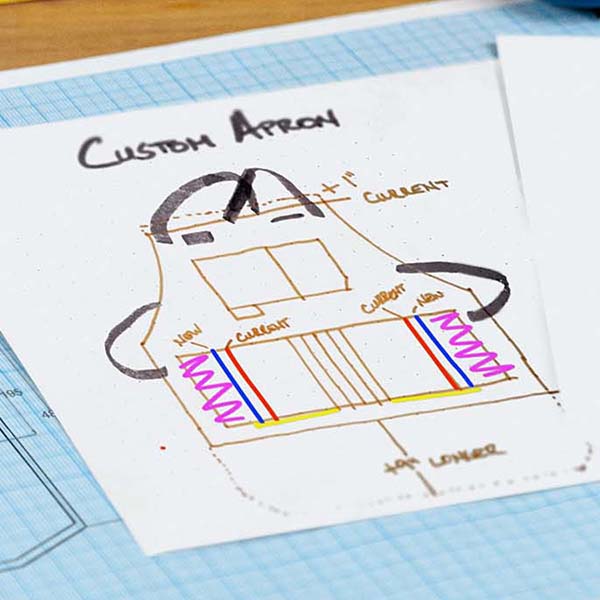
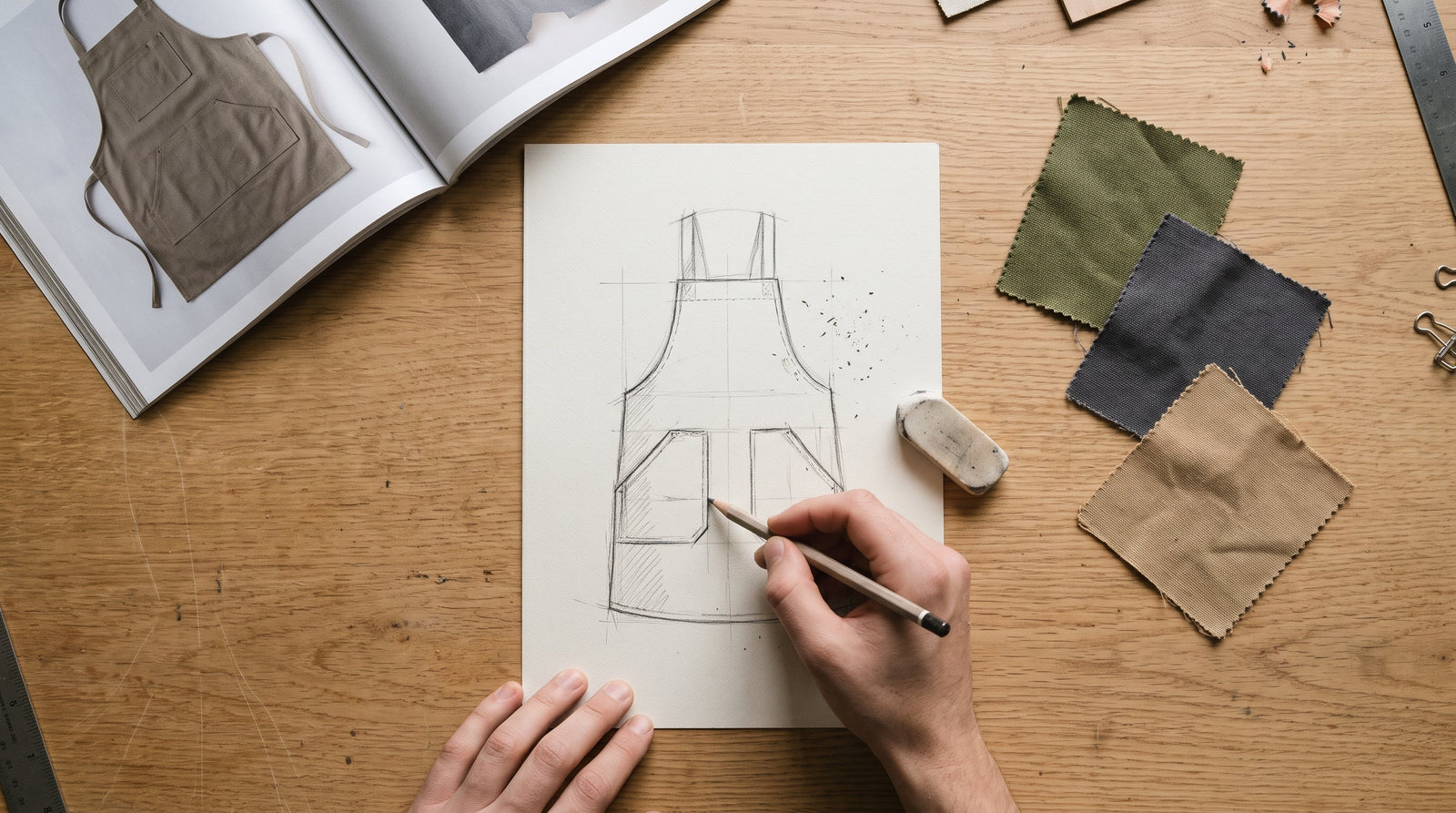
AI can help you picture a uniform. Turning that picture into something wearable requires another step. The same goes for an apron sketch, a smock photographed in a restaurant, or a mood board for a custom tool roll.
With enough time and budget, far more becomes possible: materials can be developed, hardware commissioned, and prototypes revised. But most customers have a deadline, a spending limit, or both. We often hear from people who have the budget but little time, or the time but a tight budget. The useful question is what we can make within yours.
You do not need to become a garment designer. You do need to explain what you want the item to do and give the people making it room to solve the physical details.

1. Describe the working day before choosing the look
A uniform needs to fit a person doing a job. Start there.
Who will wear it? What do they reach for? Do they spend much of the shift standing, sitting, bending, or raising their arms? What clothing will they wear underneath? How will the item be cleaned?
“A fitted black smock for our salon” gives a manufacturer a direction. “A black smock worn over a T-shirt, with room to lift both arms and pockets for these combs and clips” gives them something to work with.
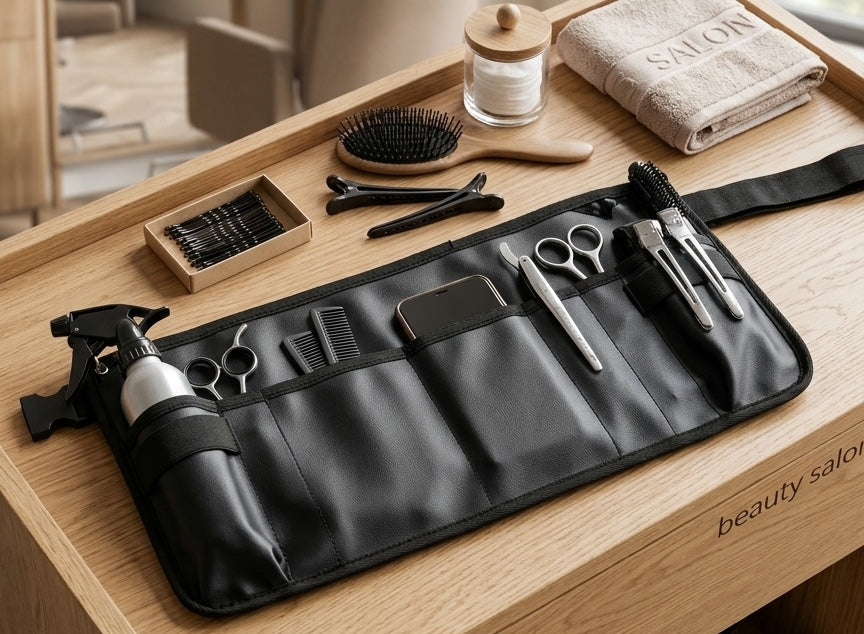
The same thinking applies to accessories. For a bill folder, describe what it must hold and how it closes. For a roll, list the objects going inside, with their dimensions. A lovely arrangement of empty compartments tells us very little about whether your actual equipment fits.
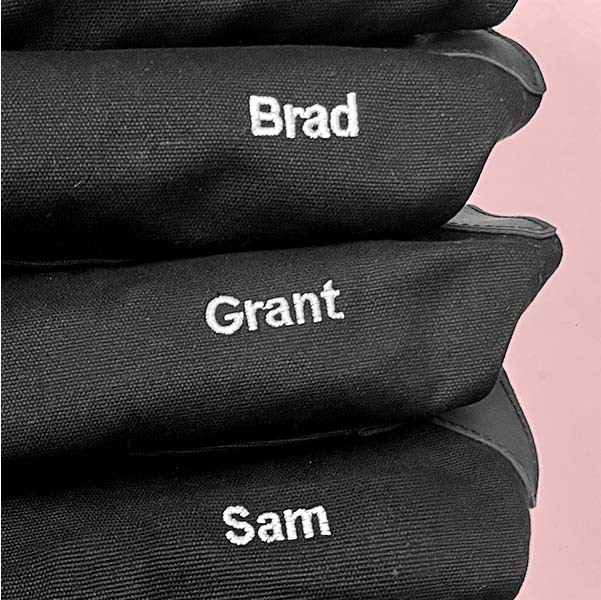
At Under NY Sky, our custom development has included barber and grooming smocks, shirts, caps, beanies, pipe rolls, and bill folders. The useful questions change with the item. The need to understand its use does not.
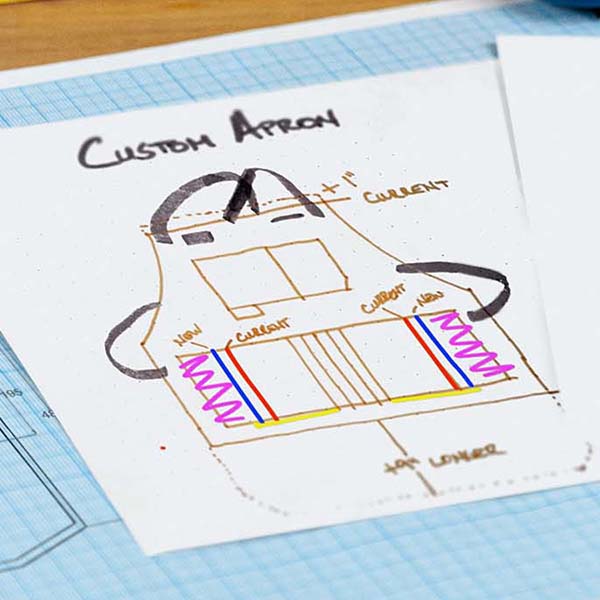
For an apron, make a list of what belongs in the pockets before deciding how many pockets you want. Our guide to choosing an apron pocket layout for your work covers that decision in more detail.
Include the cleaning routine early. A material or decorative detail that makes the look work still has to suit the way the item will be cared for.
2. Make the picture explain itself
An image can show the mood while leaving the construction entirely up for debate.
Look at the concept as though someone has to cut and join every piece. Where does a strap attach? How does the wearer get into it? Can a hand reach the pocket opening? Does the back belong to the same garment as the front?
AI-generated views can disagree. A closure may change between images, a strap may disappear behind the body without a plausible attachment, or a close-fitting garment may have no obvious way to put it on. Mark those gaps instead of asking the manufacturer to guess which version you mean.
You can use AI to explore another view, but check it against the first. A second convincing image is only useful if it describes the same item.
Send references with short notes:
-
“Keep this overall length and neckline.”
-
“The side pocket needs to hold this item.”
-
“I like this color family; an exact match is negotiable.”
-
“The buckle is inspiration. A similar available closure is fine.”
Also identify what you dislike about the items you use now. A pocket you cannot reach while seated or sleeves that pull when you lift your arms can be more useful information than another polished image.
Separate essential functions from preferences. “The roll must fit our equipment” is a requirement. “The closure must look exactly like this AI-generated clasp” may be a preference. If both are essential to you, say so, but expect the second to affect feasibility, cost, and time.
3. Let real materials shape the design
Why “just make one like this” still takes development
Sometimes the reference is an item already for sale. If another company makes it, surely reproducing it should be straightforward?
The finished product hides the work and purchasing behind it. Its maker may have developed it for a larger production run, bought materials in bulk, or commissioned fabric and hardware specifically for that brand. Finding the same thing in a photo does not mean finding those components for sale in small quantities.
For our catalog styles, we already have the patterns, established construction, and the fabrics, colors, and hardware we use to make them. A different design may require materials outside that supply. For small custom orders, we may need to buy those materials at retail, which can raise the unit cost substantially. Even then, the exact material, shade, or fitting may not be available.
Use an existing item to explain the shape, function, or details you want. Be ready to discuss alternatives rather than assume an identical result at the same price. The reference is a useful starting point, not a ready-made supply chain.
One recurring problem in our custom inquiries is a requested shape paired with a fabric that will not naturally produce it. A crisp, sculptural outline and a soft, flowing garment ask different things of a material.
Fabric behavior is measurable. Research on woven-fabric drape connects how cloth hangs with its bending properties and weight. In everyday terms, the fabric helps decide whether your design holds its shape or falls into folds.
If you love the silhouette, let the manufacturer suggest suitable materials. If a specific fabric is essential, be ready to adjust the silhouette. Trying to lock both before checking whether they work together is a reliable way to make development harder.
The exact color and buckle may be the expensive part
We also see requests for hardware that is difficult to source or would have to be custom made. That can make a small order disproportionately expensive.
An available clasp or buckle with a similar appearance and suitable function may be the better choice. The important question is what the component needs to do, followed by which available options can do it.
Fabric colors bring a similar problem. In our sourcing experience, available shades change with supplier collections and seasonal offerings. The professional fabrics we source tend to have narrower, steadier color ranges than fashion fabrics. A very particular seasonal shade can be harder to find in a material suitable for the job.
Our recommendation is to start with the fabrics and colors already offered in our catalog. That keeps the request close to materials we use and hold for our own styles. Ask us to confirm the quantity available for your project. If you need another color, more common, traditional shades are generally a more practical starting point than an unusual tone from an AI image.
Custom fabric production or dyeing may involve quantities far beyond a small order. There is no useful universal minimum to quote here; the supplier, material, and project determine that. For a small team, choosing from available shades is often the practical route.
Share your total quantity, size breakdown where relevant, and budget early. An affordable detail repeated across a large order and a specially sourced component for a handful of pieces can produce very different quotes.

Leather needs its own design decisions
If the concept uses leather, allow for some variation in shade, thickness, and weight rather than expect every piece to behave like an identical length of woven cloth. Agree on an acceptable range for the project. The type and finish matter, so “leather” alone is not a complete material specification.
The leather we use can also be too firm for folds, pleats, and tightly gathered details that work in a softer textile. We need to check those shapes against the actual leather before promising the result.
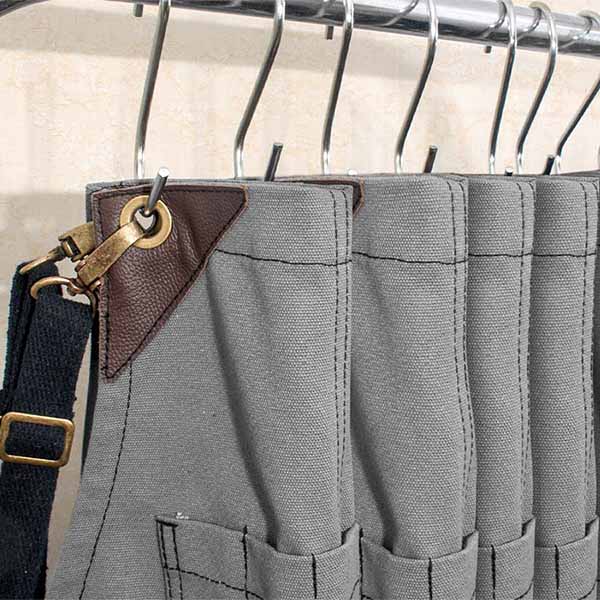
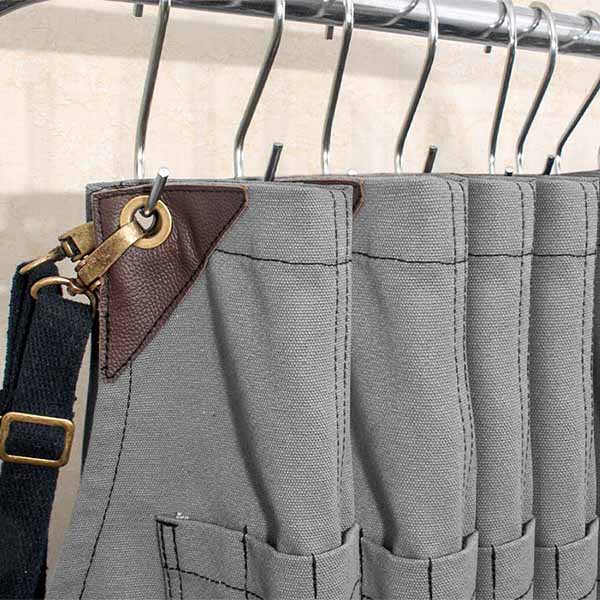
That affects attachment details too. We avoid leather straps that need to be tied against the garment fabric because, in our experience, that arrangement can wear the fabric faster. Our leather straps use buckles or a clasp-and-ring system instead. If the image shows leather ties, expect us to discuss a different closure.
Keep embroidery decisions separate from the garment shape
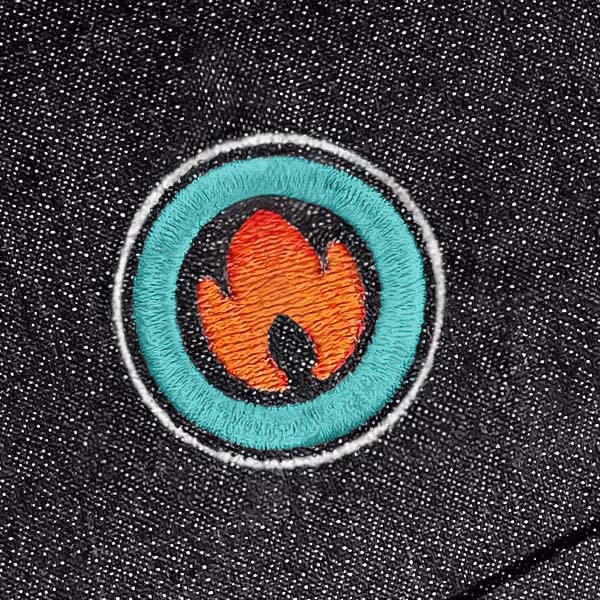
Customers also bring us AI-generated JPG artwork full of shadows, gradients, and intricate colors. It may look excellent on a screen while needing substantial simplification for the intended embroidery size.
For these projects, our practical starting point is clear shapes and a manageable selection of solid thread colors. Some embroidery techniques can produce shading, but a photographic effect is not something to assume from a reference image. The artwork and intended result need review.
Madeira advises using a physical thread shade card for precise color matching, because screen and printed colors may differ from the actual thread. That is another reason to approve physical choices rather than rely entirely on the mockup.
An AI-generated JPG or PNG is a picture, not vector artwork or a machine-ready embroidery file. Clean vector artwork can help prepare the design, but it still needs to be turned into stitch instructions, a process called digitizing. A JPG can be used as a reference; changing its file extension will not turn it into vectors or stitches. Ask what artwork preparation is needed before assuming the image is ready to embroider.
Our guide to getting your logo ready for embroidery handles the artwork side. For the garment brief, specify the intended placement and approximate size, and send the best original artwork you have for review.
An illustrative concept, made more practical
The following is a hypothetical request, not a customer story or a tested design. The proposed adjustments would still need a feasibility review.
| Concept detail | Practical adjustment to discuss | Reason |
|---|---|---|
| Soft, flowing fabric with a sharply structured outline | Choose a material suited to the outline, or soften the shape | Fabric behavior and the intended silhouette need to agree. |
| An unusual decorative clasp shown by AI | Review available closures with a similar look and suitable function | Custom hardware can add cost and sourcing time to a small order. |
| An exact muted green that has no match in the chosen fabric | Compare available shades and rank color against fabric performance | A screen color does not establish material availability. |
| A pocket that looks sleek but has an unclear opening | Specify its contents and revise the opening and placement | Storage needs usable access. |
| Leather ties knotted against garment fabric | Review a buckle or clasp-and-ring attachment | Our preference is to avoid the fabric wear we associate with that tying arrangement. |
| A shaded, intricate embroidered emblem supplied as a JPG | Review a simpler version at the intended size and the artwork preparation needed | A screen image is not a machine-ready stitch file. |
The aim is to preserve what makes the design yours while resolving the details that would stop it working.
4. Plan development before counting production days
Your opening date is fixed. A material supplier's stock does not rearrange itself around it.
Developing a new product can involve sourcing, design work, mockups, pattern development, approval, and testing before production. Delivery needs its own place in the schedule.
Even after finding the materials, we still have to make the first piece. Sometimes the chosen fabric does not work as expected once the item is assembled. That can mean finding another fabric and trying again.
Approval of that piece does not necessarily mean the whole order can start immediately. Depending on the project, we may still need to prepare or finalize the production patterns that let us repeat the design efficiently. For a very small order, we may make the items individually instead. That is hands-on work, and it still takes time.
Based on our experience at Under NY Sky, a simpler new project using materials we already have may take around one month. A complicated project that requires sourcing materials may take roughly one to two months. These are approximate project planning estimates, not promised turnaround times or substitutes for an order-specific schedule. Confirm the delivery allowance separately before treating either range as an arrival date.
Do not use a post-approval production estimate as the start-to-finish timeline for a completely new style. At that stage, important decisions have already been made.
| Part of the schedule | What needs to be resolved |
|---|---|
| Development and sourcing | Feasibility, construction, materials, components, and the proposed design |
| Review and approval | What you will review, how fit or function will be checked, and who approves the final version |
| Production | Making the approved quantity to the agreed specification |
| Delivery and opening preparation | Shipping, arrival, and time to receive and check the order before use |
A sample shipped to you adds another stretch of time
If you need a physical sample delivered for testing, say so at the beginning. The schedule must allow us to develop and make the sample, ship it to you, give you time to test and respond, make any agreed changes, and then prepare and produce the full order after approval. The finished order still needs to be shipped too.
A requested change may mean revisiting materials or construction, making another sample, or arranging another delivery. Do not assume a shipped-sample project will fit inside the approximate ranges above. Ask for a schedule that includes the sample journey, your testing window, any revisions, and the final production and delivery.
These are planning categories, not a promise that every project follows an identical sequence. Agree on the actual steps with the manufacturer, including whether a physical sample is needed and what it will cost.
Give the manufacturer both your opening date and the date you need the goods in hand. Ask for the latest realistic approval date. Assign one person on your side to collect feedback, so conflicting comments do not keep reopening decisions.
If time is already short, ask whether an existing style can meet the essential needs with fewer changes. Our custom and bulk order options are a useful place to compare that route with developing something new.
5. Copy this custom-design brief
Send this with your reference images. “Open to suggestions” is a useful answer where you genuinely have flexibility. An honest unknown is better than a specification nobody has checked.
Business and contact:
Item to develop: Apron, smock, jacket, roll, folder, or other item.
Who will use it: Roles, size range, and clothing worn underneath where relevant.
Main job: What must this item help someone do?
Movement and access: Reaching, bending, sitting, dressing, opening, closing, or retrieving contents.
Contents and dimensions: Tools, equipment, documents, or personal items it must hold.
Cleaning routine and working conditions: How it will be cleaned and what it will encounter during use.
Essential features: The functions or details we cannot compromise on.
Flexible preferences: Colors, trim, hardware, shape, or other details we are willing to adjust.
References: Images or links, with a note explaining what to keep and what to ignore in each.
Materials and colors: Preferences, known requirements, catalog options you like, and acceptable alternatives. For leather, discuss acceptable shade and thickness variation.
Branding: Intended placement and approximate size; artwork attached separately.
Quantity and sizes: Initial order quantity and size breakdown, if applicable.
Budget: Target budget; say whether it must cover development, samples, shipping, and taxes.
Dates and destination: Opening or event date, required in-hand date, and delivery location.
Sample and testing needs: Do you need a physical sample shipped before approving the full order? Where will it go, what will you test, and how much review time do you need?
Approval contact: Who can approve the design, materials, and any agreed sample?
Questions for the manufacturer: Feasibility, suggested substitutions, approval steps, costs, and a schedule including delivery.

Questions before you send the brief
Do I need technical drawings before contacting a manufacturer?
You can start a conversation with a sketch, photograph, mood board, or AI image. Add notes about use and priorities. Ask what further specifications or development work are needed before quoting or production; a reference picture is not automatically a complete manufacturing specification.
Can Under NY Sky develop accessories as well as aprons?
Yes. Our custom development experience includes garments and accessories, including smocks, shirts, caps, beanies, pipe rolls, and bill folders. Each new request still needs review for materials, construction, machinery, quantity, cost, and timing.
Can I insist on an exact color for a small order?
You can identify it as a requirement, but that does not make the right fabric available in that shade. Ask whether there is a suitable stock match and what alternatives exist. Custom fabric or dyeing may require quantities or spending that do not suit a small order.
Is changing an existing style better than starting from scratch?
It is our first recommendation when the existing construction already meets the main needs and your time or budget is tight. A new style makes more sense when those needs cannot be met with reasonable changes. Ask for a comparison before committing.
Does a sample delivered for testing fit inside the usual estimate?
Do not assume so. Sample preparation, shipping, your testing and feedback, and any revisions need time before full-order production and final delivery. Tell us at the first inquiry if you need a shipped sample so the project schedule can account for those steps.
What if my opening is sooner than the estimated development time?
State the deadline immediately and ask what is feasible. An available style or a simpler scope may provide a workable route, but only the project review can establish that. Do not assume development can be compressed into the production window.
Bring the image you love and the details that explain how it needs to work. Then send your completed brief for a custom-styling review, asking what is feasible and which materials, approvals, costs, and dates need to be agreed before the project moves forward.
Last updated: November 2, 2026
Fred Rodrigues has run Under NY Sky for 12 years, overseeing material research, purchasing, design, sales, marketing, and customer service. He’s worked on thousands of custom orders across a wide range of designs, from the first conversation with a customer to the decisions that get an item into production. Having also run other businesses, including a restaurant, Fred brings a firsthand understanding of what people need from the gear they wear through a working shift.




Leave a comment (all fields required)